
WOLVES IN THE PULPIT
- The Bible Believer A.V.1611

- Jul 9
- 5 min read
Part One
The Church Age: Why God Calls Us to Walk by Faith, Not by Sight
Why the Scriptures—Not Signs—Are the Believer's Final Authority
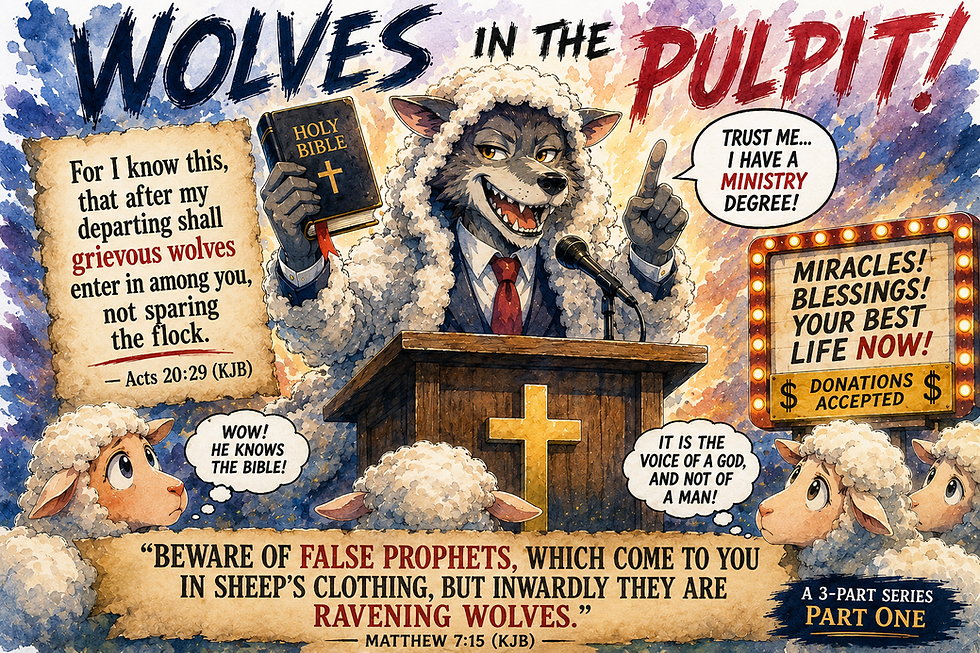
"Beware of false prophets, which come to you in sheep's clothing, but inwardly they are ravening wolves."— Matthew 7:15
Every generation of Christians has faced its own peculiar dangers.
The early church battled Judaizers who sought to place believers back under the Law. Later generations contended with Gnosticism, Romanism, rationalism, liberalism, and modernism.
Today, however, one of the greatest dangers confronting Bible-believing Christians is not open unbelief but an increasing fascination with spiritual experiences that subtly replace the authority of the written Word of God.
Across the religious world, countless professing Christians are being taught that the Christian life should be marked by visible signs, miraculous manifestations, prophetic revelations, dreams, visions, voices, and extraordinary experiences. Entire ministries are built upon claims of new revelations from God. Conferences advertise miracles more than they preach Christ. Testimonies are often measured, not by faithfulness to Scripture, but by how spectacular the experience appears.
The tragedy is that many sincere believers assume these things must be from God simply because they are supernatural.
Yet the Scriptures never teach us to judge truth by what appears supernatural.
They teach us to judge everything by the written Word of God.
That distinction is becoming increasingly important as we approach the closing days of this dispensation.
The question before us is not whether God is able to perform miracles.
He most certainly is.
The God who divided the Red Sea, raised Lazarus from the dead, and raised His own Son from the grave has never lost one ounce of His power.
The real question is altogether different.
How has God chosen to lead and instruct His Church during this present dispensation?
The answer to that question determines whether we build our lives upon God's unchanging Word or upon experiences that can easily deceive us.
Wolves Wear Wool
Our Lord issued one of the most sobering warnings found anywhere in Scripture.
"Beware of false prophets, which come to you in sheep's clothing, but inwardly they are ravening wolves." (Matthew 7:15)
Notice carefully what Jesus did not say.
He did not warn us merely about wolves.
He warned us about wolves wearing sheep's clothing.
A wolf never announces himself.
He does not enter the church introducing himself as a deceiver.
He does not stand behind the pulpit declaring himself to be a minister of Satan.
Instead, he appears gentle.
Compassionate.
Knowledgeable.
Convincing.
He speaks the language of Christianity.
He quotes Scripture.
He often possesses remarkable charisma and influence.
Yet beneath the appearance lies a dangerous reality.
The Apostle Paul echoed this warning when addressing the Ephesian elders for the final time.
"For I know this, that after my departing shall grievous wolves enter in among you, not sparing the flock." (Acts 20:29)
Notice where the danger would arise.
Not merely from outside the church.
Among you.
False teachers would infiltrate the assemblies themselves.
Paul continues,
"Also of your own selves shall men arise, speaking perverse things, to draw away disciples after them." (Acts 20:30)
The objective of every false teacher is ultimately the same.
Not to exalt Christ.
Not to magnify the Scriptures.
But to gather followers after themselves.
History has repeatedly demonstrated that Satan often accomplishes more through a pulpit than through persecution.
He has never needed to destroy the Church from the outside if he can corrupt it from within.
Satan's Unchanging Strategy
Although civilizations have risen and fallen since Eden, Satan's methods have never changed.
The first recorded words spoken by the devil were not an outright denial of God's truth.
They were a question.
"Yea, hath God said...?" (Genesis 3:1)
Before Satan denied God's Word, he first caused Eve to question it.
Once confidence in God's words was weakened, the lie became believable.
The strategy remains exactly the same today.
The devil rarely begins with complete falsehood.
His greatest deceptions are mixtures of truth and error.
They come close enough to the truth to appear convincing while leading men just far enough away to become spiritually dangerous.
Charles Haddon Spurgeon wisely observed,
"Discernment is not knowing the difference between right and wrong. It is knowing the difference between right and almost right."
That single observation explains much of modern religious deception.
The devil has never been content merely to oppose God's truth.
He counterfeits it.
He imitates it.
He corrupts it.
He substitutes something that looks genuine but lacks the authority of God's revelation.
Religion Is Satan's Favorite Disguise
Many imagine Satan working primarily through open wickedness.
The Scriptures present a far more sobering picture.
Paul writes,
"And no marvel; for Satan himself is transformed into an angel of light. Therefore it is no great thing if his ministers also be transformed as the ministers of righteousness..." (2 Corinthians 11:14–15)
Notice that carefully.
Satan has ministers.
He promotes a counterfeit righteousness.
He disguises himself as light.
His greatest weapon has never been paganism.
It has been counterfeit Christianity.
Throughout history, the devil has rarely attempted to remove the Bible from churches.
Instead, he places something beside it.
Tradition.
Religious authority.
Philosophy.
Personal experience.
Private revelation.
Dreams.
Visions.
Prophecies.
Signs.
Whenever something is elevated alongside the Scriptures, the authority of God's Word is diminished.
That is precisely how deception enters.
The Reformers rightly insisted that Scripture alone must be the believer's final authority.
Bible believers gladly affirm that truth.
But we go one step further.
We believe the God who inspired His Word has also preserved His Word.
Our confidence therefore rests, not upon what men claim God is saying today, but upon what God has already said.
The Measure of Truth
This raises an important question.
How do we determine whether a preacher, teacher, movement, or ministry is truly from God?
Do we judge by numbers?
By popularity?
By miracles?
By emotional experiences?
By eloquence?
The Scriptures give a different answer.
Luke tells us of the believers in Berea,
"These were more noble than those in Thessalonica, in that they received the word with all readiness of mind, and searched the scriptures daily, whether those things were so." (Acts 17:11)
Think about that for a moment.
The Bereans examined the preaching of the Apostle Paul himself by the Scriptures.
If an apostle's preaching was to be tested by God's written Word, how much more should every preacher, every denomination, every movement, and every religious experience be tested by the Scriptures today?
No man is our final authority.
No church is our final authority.
No denomination is our final authority.
No seminary is our final authority.
No movement is our final authority.
The Word of God alone occupies that place.
It is the unchanging standard by which every doctrine, every experience, every miracle claim, and every spiritual manifestation must be examined.
The closer we come to the return of our Lord, the more essential this principle becomes.
For the Lord Jesus Himself warned that false christs and false prophets would arise, showing great signs and wonders, "insomuch that, if it were possible, they shall deceive the very elect" (Matthew 24:24).
Supernatural power, by itself, has never been God's test of truth.
His Word is.
Yet this raises another important question.
If the Church is not to measure truth by signs and wonders, why did God give miraculous signs in the first place?
To answer that question, we must rightly divide the Scriptures and understand God's distinct dealings with Israel and with the Body of Christ.
Next in this series:
Signs, Wonders, and the Kingdom Program
Why did God give miraculous signs, and why were they primarily associated with Israel?


Comments